Principle of vibration measurements
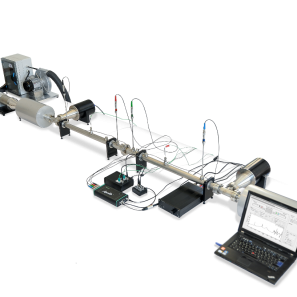
When machines and structures are mechanically excited, vibration energy is introduced. This energy propagates as structure-borne noise through the solid structure and can be radiated away from the excitation point as airborne noise. The vibration behavior is generally frequency-dependent. This means that, particularly in the range of natural frequencies, both the vibration input of the excited structure and the airborne sound radiation of the emitting structure can be very high.
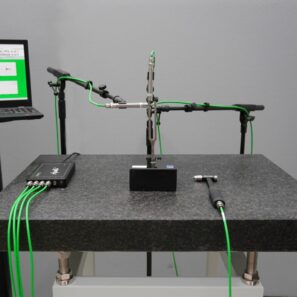
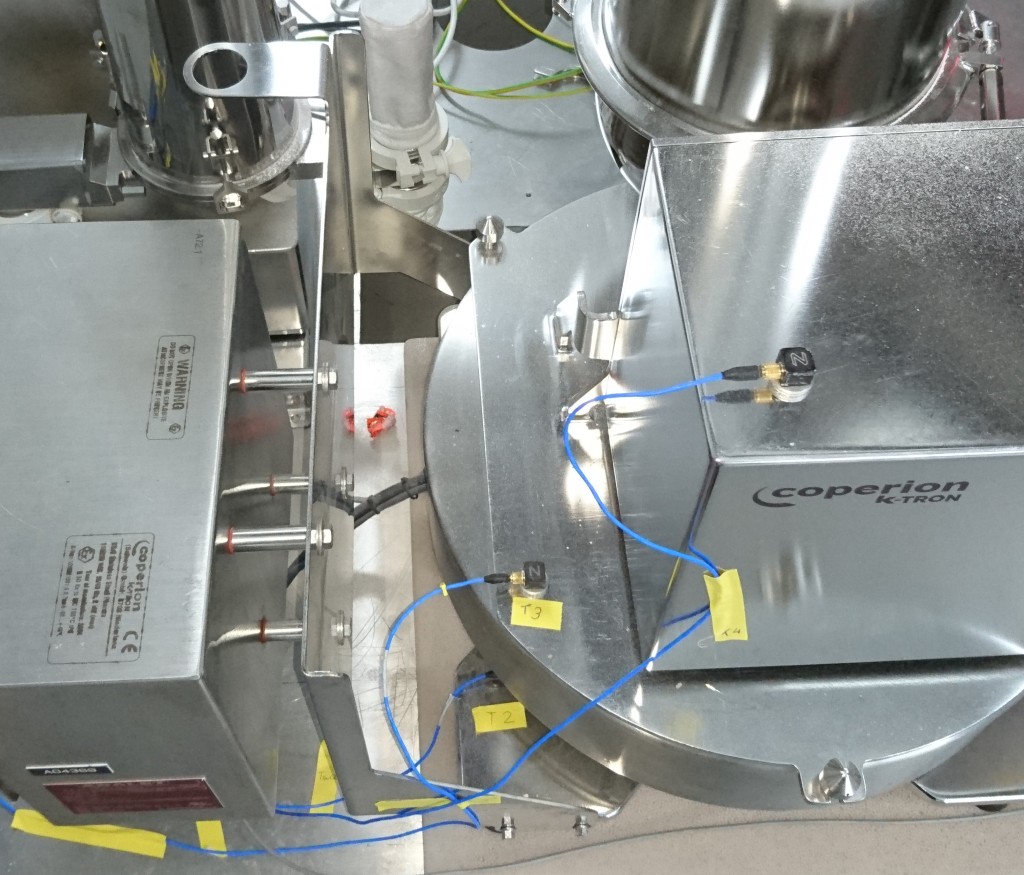
Acceleration sensors, speed sensors, seismometers, force sensors, and/or impedance measuring heads are generally used to measure the excitation and propagation of structure-borne noise. To investigate rotational excitations, the rotational speed is usually recorded in a time-synchronous manner.
In contrast to investigations in real operation (e.g., through operational vibration analysis/operational modal analysis OMA), structures of machines and devices or vibration-reducing systems (so-called vibration isolators) can also be specifically excited to vibrate using model shakers or impedance hammers. This also allows natural frequencies (e.g., through experimental modal analysis EMA), structure-borne noise transmission (e.g., through transfer path analysis TPA), and/or the radiation factor or vibration-reducing effect (insertion loss/insertion loss factor) to be determined.
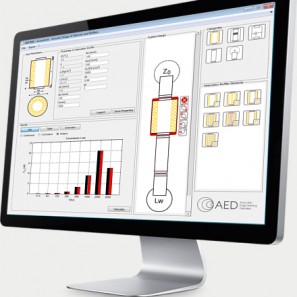
Application-oriented analysis software with an intuitive graphical user interface usually enables the analysis of measurement signals and the determination of various vibration parameters and characteristics.
Parameters of vibration
The measurement system for vibration allows the metrological determination and evaluation of the following vibration parameters, most of which are frequency-dependent
- force F, force level LF
- vibration acceleration a, acceleration level La
- vibration velocity v, velocity level (structure-borne noise velocity level) Lv
- vibration displacement x, displacement level Lx
- impedance Z
and associated parameters
- eigenfrequency (natural frequency) fr (f0)
- emission coefficient σ
- transfer function H
- insertion loss De.
Components of measuring system for vibration
The measuring system for vibration consists of the following components, among others:
Technical data (excerpt)
Acceleration sensors and accessories
- acceleration sensor uniaxial
- IEPE power supply
- frequency range: depending on the type, between 0.1 Hz and 23 kHz
- sensitivity: depending on the type, between 100 mV/g and 10 mV/g
- measurement range: depending on the type, between ±50 g pk and ±500 g pk
- sensor mass: depending on the type, between 3.2 g and 32 g
- connector: 10-32
- depending on the type TEDS
- acceleration sensor triaxial
- IEPE power supply
- frequency range: depending on the type between 0,1 Hz and 20 kHz
- sensitivity: depending on the type between 100 mV/g and 10 mV/g
- measurement range: depending on the type between ±50 g pk and ±500 g pk
- sensor mass: depending on the type between 6 g and 11 g
- connector: microtech 4-28
- depending on the type TEDS
- acceleration sensor triaxial, mini
- IEPE power supply
- frequency range: 2 Hz to 8 kHz (y, z); 2 Hz to 5 kHz (x)
- sensitivity: depending on the type between 5 mV/g and 10 mV/g
- measurement range: depending on the type between 1000 g pk and 500 g pk
- sensor mass: depending on the type between 1 g and 1,2 g
- connector: microtech 4-28
- depending on the type TEDS
- vibration calibrator
- for vibration sensors
- calibration frequency: depending on the type 159 Hz or switchable between 15,9 Hz and 1280 Hz
- calibration value acceleration / vibration velocity / vibration displacement: depending on the type 10 m/s² / 10 mm/s / 10 µm or switchable between 1 m/s² and 20 m/s²
- other available accessories
- connecting cable / cable whip acceleration sensor-data acquisition unit (e. g. 10-32 to BNC / 4-28 to 3x BNC)
- mounting plate, adhesive magnet
- adhesive wax
- et al.
Velocity sensors and accessories
- 3D seismometer
- vibration sensor acc. to DIN 45669
- IEPE power supply
- frequency range: depending on the type 1 Hz to Typ 80 Hz or 315 Hz
- sensitivity: 30 V/(m/s)
- incl. DAkkS calibration
- incl. splitter cable (3x BNC)
- IP 68
- other available accessories
- connecting cable / cable whip acceleration seismometer-data acquisition unit
- probe tips for different test surfaces (e. g. laminate, carpet)
- mounting kit for panel mounting
- et al.
Force sensors, impedance sensors, impact hammers and accessories
- force sensor uniaxial
- IEPE power supply
- frequency range: 0,001 Hz to 36 kHz
- sensitivity: 11,2 mV/N
- measurement range: 445 N
- connector: 10-32
- force sensor triaxial
- IEPE power supply
- frequency range: 0,01 Hz to 10 kHz (z); 0,001 Hz to 10 kHz (x, y)
- sensitivity: 0,56 mV/N (z); 1,12 mV/N (x, y)
- measurement range: 4,45 kN (Fz); 4,45 kN (Fx, Fy)
- impedance measuring head
- IEPE power supply
- frequency range: 1 Hz to 5 kHz (a)
- sensitivity: 100 mV/g (a); 22,4 mV/N (F)
- measurement range: ±50 g pk (a); ±222,4 N pk (F)
- connector: 10-32
- impact hammer
- instrumented test hammer with integrated force sensor
- IEPE power supply: 2 mA to 20 mA
- sensitivity: depending on the type between 22,5 mV/N and 0,23 mV/N
- measurement range: depending on the type between ±222 N pk and ±22,24 kN pk
- input voltage: 20 VDC to 30 VDC
- output voltage: 8 VDC to 14 VDC
- hammer mass: depending on the type between 4,8 g and 5,5 kg
- incl. whipping tips, additional weights, and carrying case
- other available accessories
- connecting cable force sensor- / impedance sensor- / impedance hammer-data acquisition unit
- mounting plate, adhesive magnet
- et al.
Special vibration sensors for human vibration analysis (HVMA) and accessories
- acceleration sensor for human vibrations triaxial
- IEPE power supply
- frequency range: 2 Hz to 4 kHz
- sensitivity: depending on the type between 1 mV/g and 10 mV/g
- measurement range: depending on the type between ±500 g pk and ±5000 g pk
- sensor mass: 5,3 g
- connector: microtech 4-28
- acceleration sensor for human vibrations triaxial (seat pad)
- IEPE power supply
- frequency range: 0,5 Hz to 1 kHz
- sensitivity: 100 mV/g
- measurement range: ±10 g pk
- sensor mass: 272 g
- other available accessories
- connecting cable vibration sensor-data acquisition unit
- mounting plate
- et al.
Shaker and accessories
- modal shaker
- electrodynamic shaker
- particularly suitable for experimental modal analysis and structural testing
- portable, compact and easy-to-install system solution
- max. force: depending on the type between 20 N and 267 N
- max. frequency: depending on the type between 6 kHz and 11 kHz (load-dependent)
- stroke: depending on the type between 5 mm and 36 mm
- incl. integrated amplifier
- stinger
- other available accessories
- connecting cable shaker-data acquisition unit
- et al.
Modular, scalable multi-channel data acquisition unit and accessories
- NoisePAD™
- handheld, mobile 4-channel sound and vibration analyzer (incl. PC)
- see Measuring system for room acoustics and building acoustics
- Apollo Box
- flexible and cost-effective 2- or 4-channel data acquisition system with USB interface (requires additional PC)
- see Measuring system for room acoustics and building acoustics
- Soundbook MK2
- universally applicable 2-/4- or 8-channel measuring system (incl. PC) for acoustics, vibration and general engineering measurements
- expandable with Soundbook MK2 expander to up to 40 synchronously operating measurement channels
- see Measuring system for sound power
- Soundbook MK2 Expander
- flexible, portable 8-channel sound and vibration meter (requires additional PC) with high signal bandwidth, high dynamic range and integrated sensor power supply
- see Measuring system for sound power
- driver / libraries for hardware control
- for external control of data acquisition unit for individual programming
- support among other things in MATLAB, Python, DASYLab, LabVIEW (requires respective programming environment)
Multifunctional data acquisition and analysis software Samurai
- module Octave and third octave band filters
- module Fractional octaves with real-time analyzer class 1 acc. to IEC 61260
- module RMS meter for determining RMS values with adjustable high-pass and low-pass filters
- module Transfer FRF for determining transfer functions and measurements with impulse hammer or shaker
- module Vibration meter with single and double integration according to ISO 10816
- module Human vibration multi analyzer (HVMA) for measuring and evaluating human vibrations in accordance with ISO 8041 and ISO 2631 (at least the module Octave and third octave band filters is recommended)
- module Building vibration for measuring and evaluating building vibrations in accordance with DIN 4150
- et al.
Training and evaluation
Upon request, we will train you and your employees in the handling and operation of the measurement technology and analysis software. If desired, we can also create defined evaluation scripts and/or protocol templates (e.g. in xlsx format).
Design of acoustic test benches according to standards, implementation of software solutions
The Gesellschaft für Akustikforschung also offers the design of acoustic test benches (e.g., end-of-line tests) in accordance with specific standards and/or the implementation of customized software solutions.
Calibration
Upon request, we can arrange for the input channels of the data acquisition unit to be calibrated by a DAkkS-certified body.